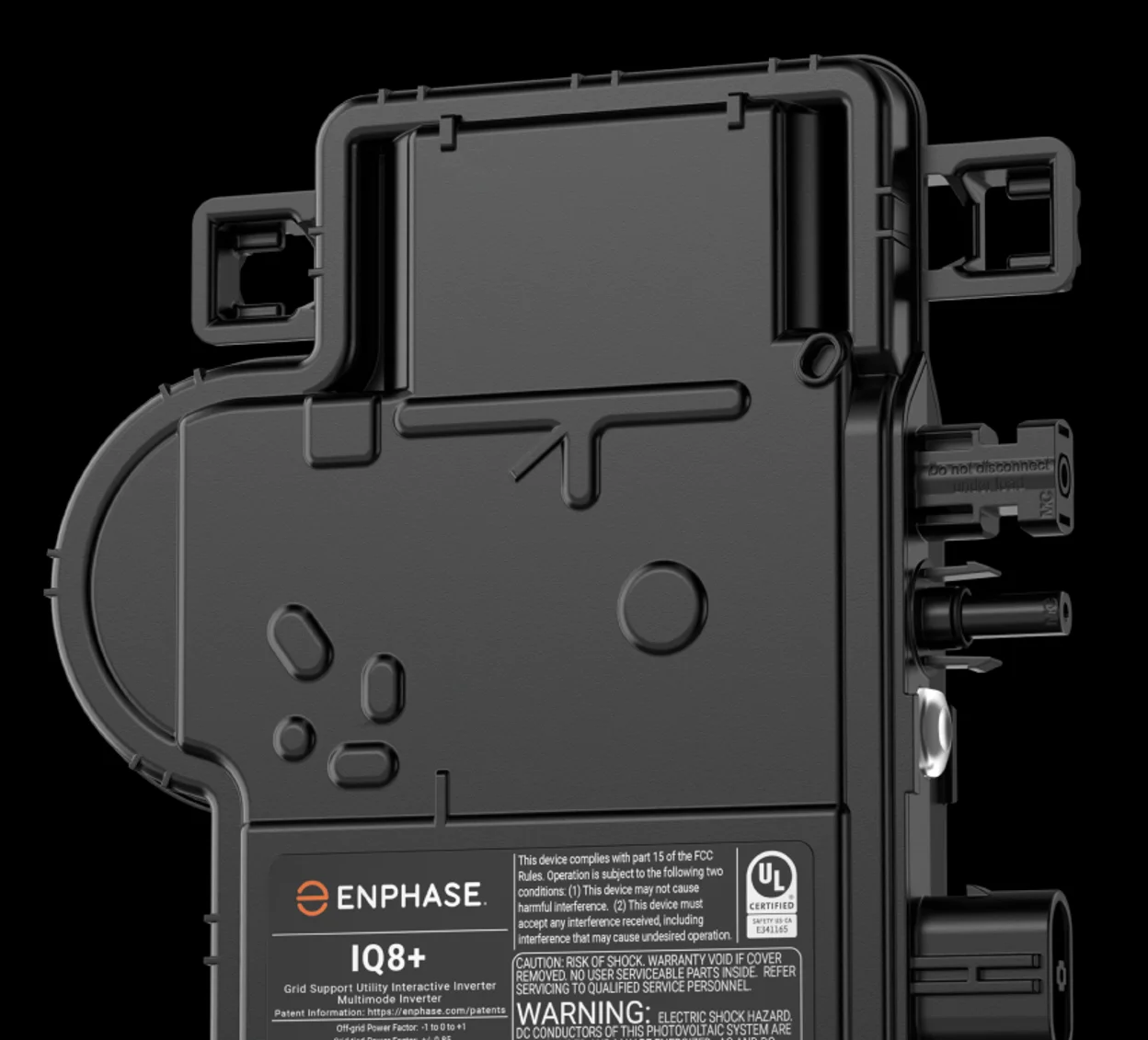
Solar Inverter Failed? Warranty Claims, Replacement Cost, and What to Do in Connecticut
Short answer: If your solar inverter fails, check the warranty first. Enphase microinverters carry 25 years, and SolarEdge inverters installed under its 2018 warranty carry 12. Those warranties replace the part but usually not the labor, so most of a replacement bill is the visit, roof access and wiring. Every day it stays down, Eversource or UI pays you nothing for the power you are not making.
This guide is for Connecticut homeowners with a system that has stopped producing, or one that is getting old enough to worry about. Every warranty term below comes from the manufacturer's own warranty document, and every utility rule comes from the RRES Program Manual (Version 2026.1). The links are in the sources list.
How do I know my solar inverter has failed?
The usual sign is a monitoring app that shows zero, or far less production than normal on a sunny day. With a central "string" inverter on the wall, one failure stops the whole system. With microinverters, one under each panel, a single failure takes out one panel and the rest keep running, so it is easy to miss without checking the app.
Before you call anyone:
- Check the app on a clear day. A low reading on a cloudy December afternoon is normal in Connecticut. A flat zero at noon in June is not.
- Check the solar breaker in your main panel and any AC disconnect outside. A tripped breaker looks exactly like a dead inverter.
- Check the monitoring gateway. Sometimes the panels are fine and only the gateway (Enphase calls it the Envoy or IQ Gateway) has lost its internet connection. If you are on RRES, the utility's production meter still counts what the system makes, even when the app goes quiet.
- Do not open the inverter. Enphase's warranty excludes units that have been tampered with or altered, and SolarEdge's excludes units opened without its written consent.
If the breaker is on and production is still missing, it is time for a service visit.
What do Enphase, SolarEdge and SMA warranties actually cover?
They cover the part, for a set number of years, if the failure is a defect. Here is what each manufacturer's own document says:
| Equipment | Warranty term | Labor covered? | Source document |
|---|---|---|---|
| Enphase IQ7, IQ8, IQ9 microinverters | 25 years from activation | No (Section 7a) | Enphase U.S. warranty, effective November 15, 2026 |
| Enphase M215, M250 microinverters | 25 years | No | Enphase warranty, effective October 1, 2015 |
| Enphase IQ Gateway | 5 years from activation | No | Enphase U.S. warranty, effective November 15, 2026 |
| Enphase Envoy (older gateway) | 2 years | No | Enphase warranty, effective October 1, 2015 |
| SolarEdge inverters | 12 years | No, unless SolarEdge agrees in writing | SolarEdge warranty, revised July 2018 |
| SolarEdge power optimizers | 25 years | No, unless SolarEdge agrees in writing | SolarEdge warranty, revised July 2018 |
A few details matter:
- Your version is the one that applied when your system was activated. Enphase lists every U.S. warranty by activation date on its warranty page, going back to 2008. SolarEdge and SMA have also revised theirs over the years.
- The clock starts early. The 2015 Enphase warranty and the 2018 SolarEdge warranty both start at installation or four months after the product shipped, whichever comes first.
- A replacement may be a newer model. Enphase may use new or reconditioned parts "of original or improved design," and SolarEdge may use refurbished parts that are at least functionally equivalent. The replacement is covered for the rest of the original term (Enphase: or 90 days, whichever is later).
- SMA depends on the model. SMA's current warranty (for purchases after May 20, 2026) gives some models 10 years only if they are registered within 12 months of commissioning. In the U.S., SMA may replace the unit on site itself or give the installer a fixed service discount per replaced inverter. SMA's own on-site work does not cover the cost of reaching equipment on a slanted roof.
Why does a "warrantied" inverter still cost money to replace?
Because the warranty sends you a box, not a crew. The current Enphase warranty says it "does not include any cost of labor" to uninstall the old unit, install the new one, or troubleshoot your electrical system. The 2018 SolarEdge warranty says labor, travel and the cost of your contractor's repair work are not covered and are borne by the buyer unless SolarEdge agrees otherwise in writing.
There is one exception worth knowing. Enphase's Labor Reimbursement Program (effective February 1, 2026) pays the installer $200 per site visit plus $25 for each microinverter replaced, but only when the replacement happens within the first two years after the equipment was activated, Enphase diagnosed it remotely first, and an RMA was issued before the work. For a system that has been on the roof since 2016, that program does not apply.
How much does a solar inverter replacement cost in Connecticut?
We do not publish a flat price, because the number depends on what we find. We quote it after a service visit. These are the things that move it:
- In warranty or out. In warranty, the part usually ships at no cost to you and you pay for the labor. Out of warranty, you also buy the replacement.
- Where the inverter is. A string inverter on a basement or garage wall is a ground-level job. A microinverter or optimizer sits under a panel, so the panel has to come off and go back on, which means roof access, safety gear and more time.
- How many units failed. One microinverter is a small job. Several at once often points to a bigger problem we need to find first.
- Whether the original model still exists. A 2014 inverter may be discontinued. The replacement then has to match your panels, your gateway and the utility's approved settings, which can mean extra parts.
- Code and permits. Connecticut's building code has moved through four editions of the National Electrical Code since many local systems went up: the 2011 NEC until September 30, 2016, the 2014 NEC until September 30, 2018, the 2017 NEC until September 30, 2022, and the 2020 NEC since October 1, 2022. We pull whatever permit your town building department requires and do the work to the code it enforces today.
- Whether it is time to replace more than one part. On an older string system, the inverter may be one of several aging pieces. We will tell you plainly whether a single swap or a bigger upgrade makes more sense.
If you are adding panels or changing the inverter's AC size, the utility rules change too, so we check that before ordering parts. Under RRES, a system's size is measured by its inverter nameplate capacity and the total cannot exceed 25 kW AC per property.
What does a dead inverter cost me in RRES or net metering credits?
Every kWh your system does not make is a kWh nobody pays you for. Under RRES, payments are based on what registers on your production meter. The 20-year tariff term is counted from the date the utility gave Approval to Operate, not from the days the system actually ran, so time spent down is time lost.
How that hits you depends on your tariff:
| Your tariff | What happens while the inverter is down |
|---|---|
| RRES Buy-All | No production means no payment. At the 2026 Buy-All rate of $0.3289 per kWh, every 1,000 kWh not produced is $328.90 not paid. Earlier application years have their own fixed rate. |
| RRES Netting | Your home buys all of its power from the grid at the retail rate, and no excess credits build up. |
| Older net metering (pre-2022) | Same as Netting: you buy everything from Eversource or UI until production comes back. |
The $328.90 figure is just $0.3289 times 1,000 kWh. Your own loss depends on how long the system is down and how much it normally makes in that season. A failure in May or June costs far more than one in January, so it pays to check your app every week or two, especially in late spring.
For more on how each option pays, see our guide to RRES Netting vs. Buy-All and our Connecticut net metering explainer.
How do I file an inverter warranty claim?
Through your installer or directly with the manufacturer, and quickly. The steps from the manufacturer documents:
- Enphase: follow its Return Merchandise Authorization (RMA) procedure. Claims must be made within the warranty period and within 90 days of discovering the defect. You may be asked for a purchase receipt. If Enphase asks for the failed unit back, it has to arrive within 60 days of the RMA, or Enphase can bill the list price of the replacement.
- SolarEdge: report the defect promptly after you find it, with a short description, the serial number, and proof of purchase or the warranty certificate. The serial number label has to be legible and attached.
- SMA: notify SMA within the warranty period. If SMA sends a replacement first, the failed unit has to go back within 30 days or SMA can charge for it.
One Connecticut-specific note: Enphase's current warranty normally requires product registration within 45 days of installation, but it states that this registration requirement does not apply to residents of Connecticut and other states that forbid it.
If you bought a house that already had solar, check whether the warranty followed you. Enphase requires a new owner to file a Change of Ownership form and pay a transfer fee within 30 days of the transfer. The 2018 SolarEdge warranty transfers to a new owner as long as the equipment stays in the country where it was installed.
What should I do first if my inverter stops working?
Work through it in this order:
- Confirm it is a real failure: app, breaker, disconnect, gateway.
- Find your paperwork: installer contract, inverter brand and model, install date, serial numbers.
- Call your original installer if they are still in business. They usually hold the monitoring access and the manufacturer account.
- If they are not, call a licensed Connecticut electrical contractor who services solar. We take warranty claims to the manufacturer and do the replacement.
- Ask for a written quote that separates the part, the labor and any permit or code work.
West Electric is a licensed Connecticut electrical contractor based in East Hartford. Our residential solar service team repairs inverters and helps with warranty claims for homeowners in Manchester, Glastonbury, West Hartford and Hartford, in both Eversource and UI territory. You can also read about the inverter brands we install or solar installation in Connecticut.
System down right now? Book a no-cost estimate and tell us the brand and install year, and we will tell you what we need to see.
Frequently asked questions
Does a solar inverter warranty cover the labor to replace it?
Usually not. The Enphase, SolarEdge and SMA warranties we reviewed cover the replacement part, not the cost to take the old unit off and put the new one in. Enphase separately reimburses installers $200 per site visit plus $25 per microinverter, but only for replacements done in the first two years after the system was activated.
How long is the warranty on an Enphase microinverter?
Enphase IQ7, IQ8 and IQ9 microinverters carry a 25-year limited warranty from the activation date under Enphase's current U.S. warranty. Older M215 and M250 microinverters also carried 25 years under the 2015 warranty. The exact terms depend on the warranty version in effect when your system was activated.
How long is the SolarEdge inverter warranty?
SolarEdge's July 2018 Limited Product Warranty gives inverters 12 years and power optimizers 25 years, starting at installation or four months after shipment, whichever comes first. A SolarEdge inverter installed in Connecticut in 2014 would be past that 12-year term by 2026.
Do I still get RRES payments while my inverter is broken?
Not for the power you do not make. RRES payments are based on the kWh registered on your production meter, so a dead inverter earns nothing until it is fixed. The 20-year tariff term is counted from Approval to Operate, not from the days the system actually ran.
Does the inverter warranty transfer when I buy a house with solar?
It can, but you may have to act. Enphase requires the new owner to file a Change of Ownership form and pay a transfer fee within 30 days of the transfer to keep coverage. SolarEdge's 2018 warranty transfers to a new owner as long as the equipment stays in the country where it was installed.
Related West Electric pages
Sources
- Enphase Limited Warranty, IQ Microinverters, IQ Gateway and Communication Devices, U.S., effective on or after November 15, 2026, Enphase Energy (checked November 27, 2026)
- Enphase Energy Limited Warranty, United States and Canada, effective October 1, 2015 (M215, M250, Envoy), Enphase Energy (checked November 27, 2026)
- Labor Reimbursement for Warranty Service, North America, effective February 1, 2026, Enphase Energy (checked November 27, 2026)
- Enphase warranties for the U.S. and U.S. territories, listed by system activation date, Enphase Energy (checked November 27, 2026)
- SolarEdge Limited Product Warranty, revised July 2018 (copy of the SolarEdge document hosted by Solartown), SolarEdge Technologies (checked November 27, 2026)
- SMA Limited Factory Warranty, COM-RES-GB-en-88, for purchases after May 20, 2026, SMA Solar Technology (checked November 27, 2026)
- Residential Renewable Energy Solutions Program Manual, Version 2026.1 (Docket 25-08-02, Order 23, Attachment 01B), Eversource and United Illuminating, filed with PURA (checked November 27, 2026)
- History of the Connecticut State Building Code, Connecticut Department of Administrative Services, Office of the State Building Inspector (checked November 27, 2026)
Program rules, rates and incentive levels change. We check them at every estimate.
West Electric is a licensed Connecticut electrical contractor (ELC.0197545-E1) in East Hartford, installing solar, home batteries, EV chargers and generators across the state since 2009.