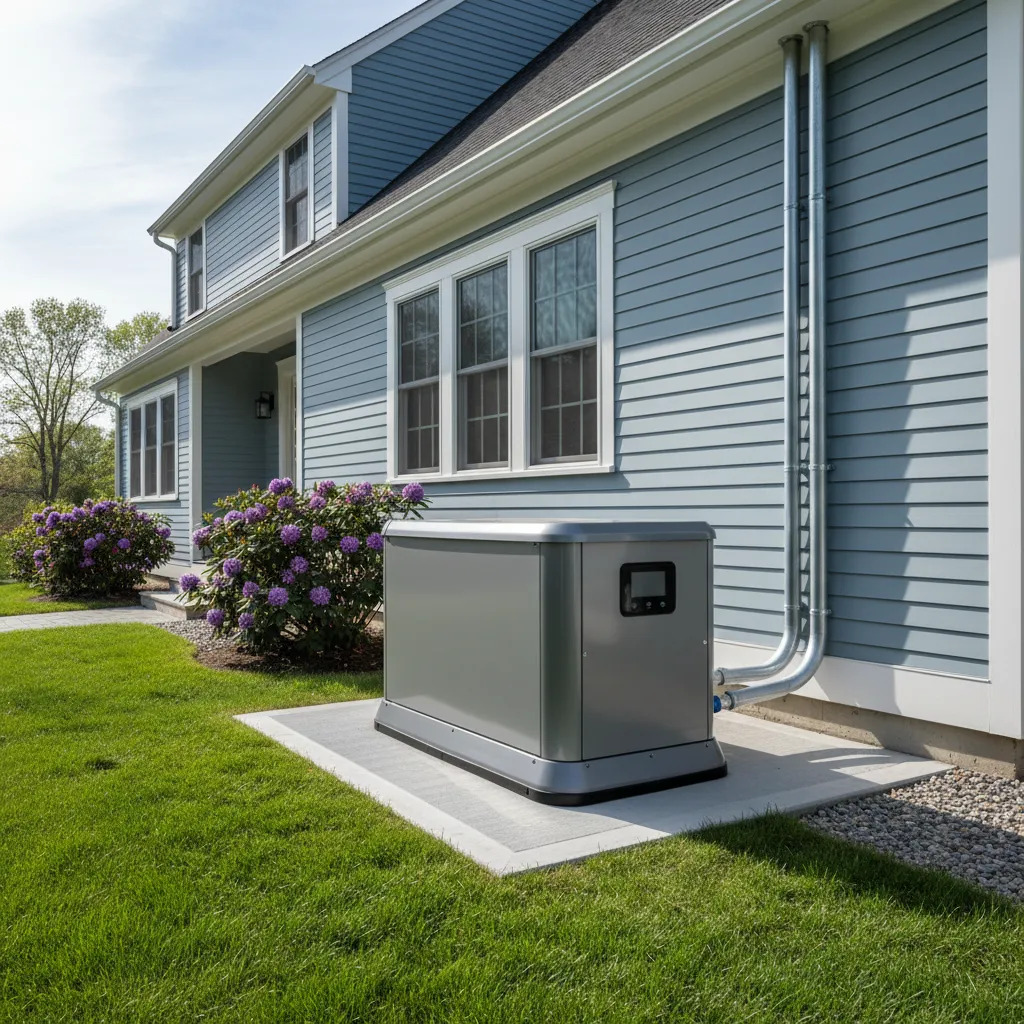
Generator Sizing Guide for Connecticut Homes: How Many kW Do You Need?
The most common mistake Connecticut homeowners make when buying a standby generator is choosing the wrong size. Too small and you cannot run your heat pump during a winter storm. Too large and you pay thousands more upfront for capacity you will never use. This guide walks through how to calculate the right generator size for a Connecticut home and explains the options at each tier.
How Generator Sizing Works
Generator size is rated in kilowatts (kW). You need to know two numbers: the starting (surge) wattage and the running wattage for each load you want to back up. Most appliances draw 2-3x their running wattage at startup, especially motors (heat pumps, well pumps, air conditioners). The generator must handle the peak surge of the largest motor that could start while other loads are running.
There are two backup strategies with different sizing implications:
Essential loads only
Back up refrigerator, lights, internet, some outlets, sump pump, and possibly one heating zone. An 11-13 kW generator handles this well for most Connecticut homes. This is the most common choice for budget-conscious homeowners.
Whole-home backup
Back up everything including central air conditioning or a heat pump, electric range, electric dryer, and EV charger. Requires a 20-24 kW generator for most Connecticut homes. Required if you have an all-electric home or rely on a heat pump as your primary heat source.
Load Calculations by Appliance
Use this table to estimate your home's backup load requirements. Add up the running watts for everything you want to power, then add the starting surge of your largest motor load:
| Appliance | Running Watts | Starting Surge |
|---|---|---|
| Refrigerator | 150-400 W | 800-1,200 W |
| Sump pump (1/2 hp) | 300-500 W | 1,000-1,500 W |
| Well pump (1 hp) | 750-1,000 W | 2,000-3,000 W |
| Central A/C (3 ton) | 3,000-4,000 W | 8,000-12,000 W |
| Cold-climate heat pump (3 ton) | 2,500-5,000 W | 6,000-9,000 W |
| Electric furnace | 8,000-12,500 W | N/A (resistive) |
| Gas furnace (fan only) | 600-800 W | 1,200-1,500 W |
| Gas boiler (circulator) | 200-400 W | 600-800 W |
| Lights + outlets (typical home) | 2,000-4,000 W | N/A |
| Electric range (one burner) | 1,200-2,000 W | N/A |
| Electric dryer | 4,000-5,500 W | 5,000-6,500 W |
| EV charger (Level 2, 30A) | 7,200 W | 7,200 W |
Generac Size Guide for Connecticut Homes
Generac is the most widely installed standby generator brand in Connecticut. Here is how their residential lineup maps to typical Connecticut home configurations:
Generac 11 kW (Guardian 11kW)
Best for: Essential loads (fridge, lights, sump pump, internet, gas furnace fan, a few circuits). Does NOT handle central A/C or heat pump. Good fit for homes with gas heat that just need power for basic comfort and sump pump during extended outages. CT installed cost: $6,500-$10,000.
Generac 16 kW (Guardian 16kW)
Best for: Essential loads plus one zone of A/C or a mini-split heat pump. Handles most Connecticut homes with gas heat + one A/C unit. Cannot run a whole-home heat pump at full load. CT installed cost: $8,000-$12,500.
Generac 20 kW (Guardian 20kW)
Best for: Whole-home backup for homes up to 3,000 sq ft with gas heat + central A/C, or homes with a cold-climate heat pump as the primary heat source. The most popular size for full-home coverage in Connecticut. CT installed cost: $9,500-$14,000.
Generac 22-24 kW (Guardian/Protector series)
Best for: Larger homes (3,000-5,000 sq ft), homes with all-electric heating (heat pump + electric resistance backup), or homes that want to include an EV charger circuit. CT installed cost: $11,000-$16,500.
Natural Gas vs Propane: The Connecticut Fuel Decision
Connecticut has extensive natural gas distribution infrastructure in urban and suburban areas, but many rural and shoreline towns have no gas service. Your fuel choice affects both installation cost and ongoing operating cost:
| Factor | Natural Gas | Propane |
|---|---|---|
| Availability in CT | Most towns served by Eversource Gas or Southern CT Gas | Available anywhere via propane delivery |
| Fuel storage required | No tank - draws from utility line | Above-ground or buried tank ($1,500-$3,500) |
| Fuel supply during outage | Continuous (utility rarely fails) | Limited by tank size (often 100-500 gallons) |
| Cost per equivalent BTU | Generally lower in CT | Higher, but stable pricing available with lock-in contracts |
| Generator efficiency | Slightly higher on natural gas | Uses ~30% more propane vs nat. gas for same output |
For Connecticut homes with natural gas service: use natural gas. For homes without gas service: propane is the standard choice. A 500-gallon propane tank provides approximately 5-7 days of continuous operation for a 20 kW generator running at 50% load.
Transfer Switch: Automatic vs Manual
Every standby generator requires a transfer switch that disconnects your home from the grid and connects the generator. There are two types:
Automatic Transfer Switch (ATS)
The generator starts automatically within 10-30 seconds of a power outage and transfers the house to generator power without any action from the homeowner. Required for standby generators. Included in the installed price from West Electric. This is what makes a standby generator different from a portable generator.
Manual Transfer Switch
Used with portable generators. You must manually start the generator, connect it to the transfer switch, and flip the switch. Not applicable to standby generators. If you are considering a portable generator as a stopgap, a manual transfer switch ($300-$800) is the safe way to connect it to your home wiring without risking backfeed to the utility.
Connecticut Installation Requirements
Standby generator installation in Connecticut requires:
- Electrical permit from your town building department
- State DCP electrical inspection after installation
- Gas permit (if connecting to natural gas) from the local building department
- Setback compliance: generators must be placed a minimum distance from windows, doors, and the property line per local zoning (typically 5-10 feet, varies by town)
- Propane tank permits: buried propane tanks often require a separate permit and setback from the structure
West Electric manages all electrical permits and coordinates with your gas company or propane supplier. We handle the interconnection with Eversource or UI and schedule the state electrical inspection.
Get a Sized Generator Quote for Your Connecticut Home
Tell West Electric your fuel type, heating system, and which loads you want to back up. We will recommend the right generator size and give you a firm installed price including all permits.
GET A FREE GENERATOR ESTIMATEWest Electric is Connecticut's trusted electrical contractor, providing professional insight into the latest energy and safety trends.
More from the blog
Solar
How to Save on Energy with Solar
Discover how high-efficiency solar panels can drastically reduce your monthly utility bills.

EV Charging
EV Charging: Home vs Public
Understanding the benefits of installing a Level 2 home charger for your electric vehicle.
Safety
Preventing Electrical Fires
Key safety tips and inspection schedules to keep your home's electrical system safe.
Ready for an estimate on your project?
Free site visit. Written quote. Licensed Connecticut electricians.
Get a Free Estimate